You uploaded a clean list, wrote a decent template, hit send — and the dashboard says 62% delivered. A third of your audience never got the message, and you paid for every one of them. A 60–70% delivery rate on WhatsApp marketing campaigns is one of the most common complaints we hear from businesses in India, and the frustrating part is that it's rarely a "bad list" problem. It's usually the lane your messages travel in and the health of your WhatsApp number. Here is exactly why marketing sends get throttled to 60–70%, and the levers that move it back toward 95%+.
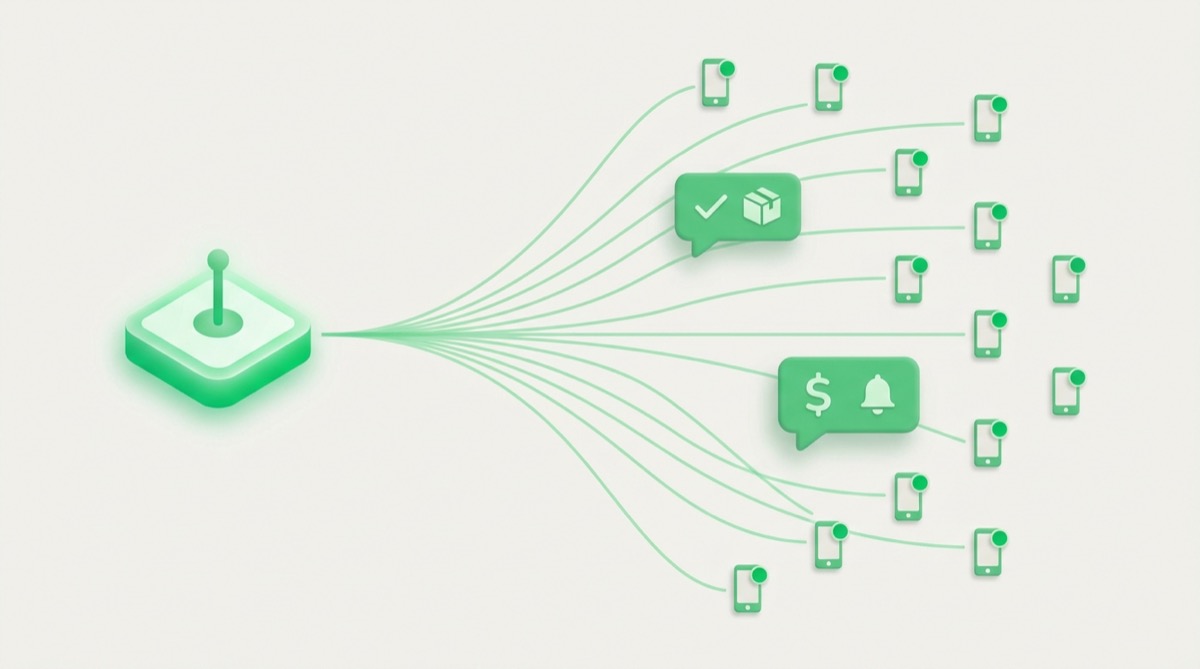
First, what "delivery rate" actually measures
On WhatsApp there are three states, and mixing them up hides the real problem:
- Sent — Meta accepted the message from you.
- Delivered — it reached the recipient's device (one grey tick → two grey ticks).
- Read — the recipient opened it (two blue ticks).
Delivery rate is delivered ÷ sent. When it sits at 60–70%, it means Meta accepted your messages but a large chunk never landed — which points at either your number's standing with Metaor the message category, not your copy.
Why marketing campaigns get throttled to 60–70%
1. Marketing-tier frequency capping
Meta applies a per-user frequency cap to marketing-category template messages. If a person has already received several marketing messages from businesses in a short window, Meta simply does not deliver another marketing template to them — regardless of how good your offer is. On a large promotional blast, this alone can knock 20–30% off delivery, and it gets worse the more marketing traffic your recipients are already receiving.
2. A yellow or red Quality Rating
Every WhatsApp number carries a Quality Rating (green / yellow / red) and a messaging limit tier. Blocks, reports and "this was spam" signals drag the rating down. Once it slips to yellow or red, Meta lowers your daily reachable audience and throttles delivery — so the same campaign that delivered at 95% last month delivers at 65% after a couple of aggressive sends. Marketing content is judged far more harshly here than transactional content.
3. Marketing opt-in friction
Marketing templates require explicit marketing opt-in. Numbers that never opted in — or opted in long ago and forgot — are more likely to block or ignore, which feeds back into the Quality Rating and the frequency cap above. A list that looks "clean" on a spreadsheet can still be full of low-intent recipients as far as Meta is concerned.
4. Aggregator hops between you and Meta
Many WhatsApp tools are resellers sitting on top of another aggregator, which sits on top of Meta. Every hop adds latency, retries and a place for messages to silently fail or get rate-limited before they ever reach Meta's Cloud API. You see it as "undelivered" with no clear reason.
How to get delivery back to 95%+
Route qualifying content through the utility lane
This is the single biggest lever. A large share of what businesses send in "marketing" campaigns is not really promotion — it's order updates, payment reminders, delivery alerts, appointment nudges, renewal notices. That content belongs in Meta's utility template category, which is not subject to the marketing frequency cap, reaches your whole customer base rather than only marketing opt-ins, and costs less per message. Move everything that genuinely qualifies into the utility lane and the throttling that was capping you at 60–70% largely disappears. (Overtly promotional content still has to go marketing — you can't disguise a discount blast as a utility message, and Meta will re-categorise it if you try.)
Protect your Quality Rating
- Honour STOP/opt-out instantly — one ignored opt-out does outsized damage.
- Keep templates clean: no all-caps, no naked URLs, no misleading buttons.
- Match category to content — marketing copy inside a utility template is the #1 rejection and re-categorisation trigger.
- Warm up new numbers gradually instead of blasting on day one.
Send on a direct Meta Cloud API connection
Cutting the aggregator hops out removes a whole class of silent failures and gives you real-time, per-message delivery status instead of a black box. QuickAuth connects directly to the official Meta WhatsApp Business Cloud API as a Tech Provider — no reseller or middle-aggregator between your campaign and Meta.
Monitor deliverability continuously, not after the fact
Delivery decay is gradual. By the time a campaign obviously underperforms, your Quality Rating has usually been sliding for days. Watching quality, tier and per-template delivery in real time lets you catch and fix a slide before it costs you a whole campaign.
Where QuickAuth fits
Teams that move their sends onto QuickAuth typically see delivery climb back into the 95%+ range — because QuickAuth is built around exactly this problem. It connects directly to Meta's WhatsApp Cloud API as a Tech Provider (no aggregator markup, no proxy layer), uses intelligent template categorisation to route qualifying content through the higher-delivering utility lane by default, and surfaces Quality Rating, messaging tier and template-level delivery in one dashboard so a slide never catches you by surprise. Same Meta API, same policies — your messages just travel in the lane they actually belong in, on a healthy number.
To be straight about it: no provider can "guarantee" a delivery number on marketing-category sends, because Meta's frequency cap and quality throttling sit above every provider. What moves the needle is routing qualifying content into the utility lane and keeping your number healthy — and that is precisely what QuickAuth automates.
If your WhatsApp marketing is stuck in the 60–70% range, the fastest way to see what's dragging it down is our free WhatsApp delivery audit — you'll get your real delivery rate and exactly what a bad rate is costing you within 24 hours. Or talk to us about moving your sends onto a direct Cloud API connection with delivery-optimised routing.