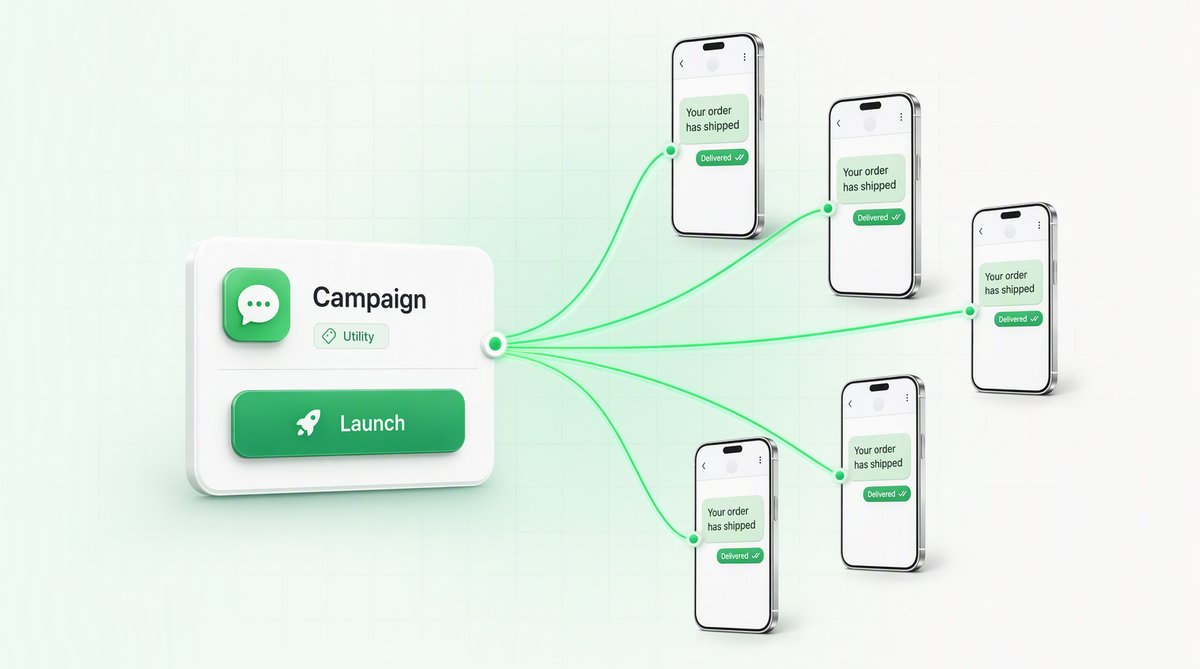
Most teams think of WhatsApp campaigns as a marketing channel: build a list of opted-in subscribers, push promotions, watch a chunk of them unsubscribe or get filtered. But a large share of what businesses actually send in bulk is not promotion at all — it is order updates, payment reminders, delivery alerts, appointment nudges. That content belongs in Meta's utility template lane, and routing it there changes the economics: you reach your whole customer base instead of just marketing subscribers, you pay less per message, and you keep your WABA quality rating green. Here is how the two lanes differ, what genuinely qualifies as utility, and how to run bulk sends without putting your number at risk.
Utility vs marketing: two different lanes
Every WhatsApp template you send is classified by Meta into a category, and the category — not your intent — decides the rules, the price, and the quality scrutiny. The three categories are AUTHENTICATION (OTPs), UTILITY, and MARKETING. For bulk business messaging, the meaningful split is the last two:
                    UTILITY                  MARKETING
Purpose       Transaction / account     Promotion / re-engagement
              follow-up tied to a       (offers, launches, "we
              specific user action      miss you")
Opt-in        Implied by the            Explicit marketing opt-in
              transaction               required
Audience      Anyone who transacted     Only opted-in subscribers
Per-msg cost  Lower (India)             Higher (India)
Quality risk  Low — users expect it     High — blocks & reports
Delivery      Reaches the full list     Gated by opt-in + filtering
The difference is not cosmetic. A utility template addressed to a customer who just placed an order is something they expect, so it draws almost no blocks or "report spam" taps — the two signals that drive your quality rating down. A marketing template, even a well-written one, fights for attention and accumulates negative feedback at a far higher rate. Lower complaints mean a healthier number, which means higher messaging tiers and better deliverability across everything you send, OTPs included.
What actually qualifies as utility
This is the crux, and it is worth being precise. A message qualifies as utility when it follows up on a specific transaction or account event that the recipient initiated or is part of. Concretely:
- Order updates — confirmation, packed, shipped, out for delivery, delivered, delayed, cancelled.
- Payment alerts — payment received, payment failed, invoice due, EMI reminder, refund processed, low-balance notice.
- Appointment & booking reminders — booking confirmed, slot reminder, reschedule notice, service-due nudge.
- Account & service notifications — subscription renewal, plan expiry, ticket status, document ready, KYC pending.
What ties all of these together: the message is about something the customer did or has with you, the timing is driven by a real event, and the recipient would reasonably expect the notification. If you can name the triggering event and the customer record it attaches to, it is almost certainly utility.
What does not qualify: discount codes, flash-sale announcements, "new collection" broadcasts, win-back offers, cross-sell pushes with no transaction behind them. Those are marketing, full stop — and dressing them up in utility language is exactly the mistake that gets templates rejected or accounts flagged. More on that in the honest-limits section below.
Audience segmentation: who gets the message
The reason the utility lane reaches your whole customer base is that it does not depend on a separate marketing opt-in. Anyone who has a live transaction or account relationship with you can receive a relevant utility notification. But "everyone" is still the wrong send list — relevance is what keeps the lane clean. Segment by the event, not by a static list:
- Trigger-based segments. Build the audience from the event itself — "customers with an order shipped today", "invoices due in 3 days", "bookings for tomorrow". Each recipient gets a message that maps to their own record.
- Suppress the irrelevant. Exclude anyone the event does not apply to. A payment reminder to someone who already paid is the kind of mismatch that produces a block.
- Respect opt-outs. Even for utility, honour STOP replies and per-merchant exclusions so a customer who asked to be left alone is dropped from future sends.
- De-duplicate per event. One order should not generate three near-identical "shipped" messages because three systems fired. Collapse to one notification per real event.
QuickAuth's campaign tooling lets you build these segments from your own customer and transaction data and send a single utility template across the matched audience, with the per-recipient variables (order ID, amount, date) filled in from each record.
- Build the audience from the event, not a listCustomers with an order shipped today, invoices due in three days, bookings for tomorrow.
- Suppress everyone the event does not apply toA payment reminder to someone who already paid is exactly the mismatch that produces a block.
- Collapse to one notification per real eventOne order should not generate three near-identical “shipped” messages because three systems fired.
- Drop anyone who asked to be left aloneHonour STOP replies and per-merchant exclusions, even on the utility lane.
- Shape the rate to the tier you actually holdRamp along 250 → 1K → 10K → 100K → unlimited rather than jumping to the ceiling.
- Schedule it for when the message is usefulA delivery alert at 9am, not 2am. Smooth traffic reads as legitimate — a single wall of messages does not.
Then put a DLT-registered SMS fallback under the time-critical ones, so a payment due today still lands.
Rate-shaping and scheduling to protect the WABA
Even perfectly-categorised utility content can hurt you if you send it wrong. A new or lightly-warmed number that suddenly emits fifty thousand messages in a flat burst looks, to Meta's systems, exactly like a compromised account. The pattern is the flag, not just the volume. Protect the number with two habits:
- Rate shaping. Ramp volume so it tracks your messaging tier (250 → 1K → 10K → 100K → unlimited unique users / 24h) rather than jumping straight to the ceiling. Let early engagement — reads, replies — earn the next step before you take it. This is email IP-warming logic applied to WhatsApp.
- Scheduling. Spread a large send across a window instead of one spike, and time it for when the message is genuinely useful (a delivery alert at 9am, not 2am). Smooth, well-timed traffic reads as legitimate; a single wall of messages does not.
QuickAuth applies adaptive rate shaping on bulk sends by default and lets you schedule campaigns, so a large utility broadcast goes out as a paced, tier-aware stream rather than a burst that trips quality systems.
The SMS safety net
WhatsApp utility delivery is high, but it is never 100% — some recipients do not have WhatsApp, have an inactive number, or simply do not connect in time. For genuinely time-sensitive utility content (a payment due today, a delivery happening now), pair the WhatsApp send with a DLT-registered SMS fallback: if WhatsApp does not deliver within a window, the same notification goes out over SMS. You get WhatsApp's economics and reach on the bulk of the list, with SMS catching the tail so the important messages still land. The same multi-channel routing that powers OTP fallback applies to utility campaigns.
The honest limits — do not disguise marketing
The utility lane is powerful precisely because it is honest, and that honesty is load-bearing. A few hard rules:
- Content must genuinely qualify. You cannot route a promotion through utility by softening the wording. Meta classifies templates on submission and re-classifies based on content; a "your order is ready — and here's 20% off your next one" template will get pulled into marketing or rejected. Keep the promotional ask out of utility templates entirely.
- One purpose per template. A utility message does one job: inform the user about their event. The moment it also tries to sell, it stops being utility.
- No fabricated triggers. Inventing a fake "account update" to have an excuse to message a dormant list is the disguise Meta is built to catch. If there is no real event, do not manufacture one — run a proper marketing campaign with proper opt-in instead.
- Marketing still has its place. When you genuinely need to promote, use the marketing lane honestly: collect opt-in, send to subscribers, accept the higher cost. The two lanes are complementary, not interchangeable.
The payoff for staying honest is real: most businesses discover that a surprisingly large fraction of their "campaign" volume was always utility in disguise — transactional content they were wrongly pushing through marketing. Reclassifying it correctly is not a loophole; it is fixing a mistake, and it unlocks both reach and cost savings without touching a single line of promotional copy.
Putting it together
Bulk WhatsApp done right is mostly a categorisation and discipline problem. Route every message that genuinely is utility through the utility lane, segment by the triggering event so each recipient gets something relevant, shape and schedule the send so the volume looks legitimate, and keep an SMS fallback under the time-critical ones. Do that and you reach your full customer base — not just marketing subscribers — at a lower per-message cost and with a quality rating that stays green. QuickAuth's utility-lane routing, audience segmentation, rate shaping and SMS safety net are built to make this the default path. See the WhatsApp utility and WhatsApp marketing pages for what each lane includes, and our template categorisation playbook for getting utility templates approved the first time.